How a barrel sauna heats and vents
Last updated: By The SaunaIndex Bench
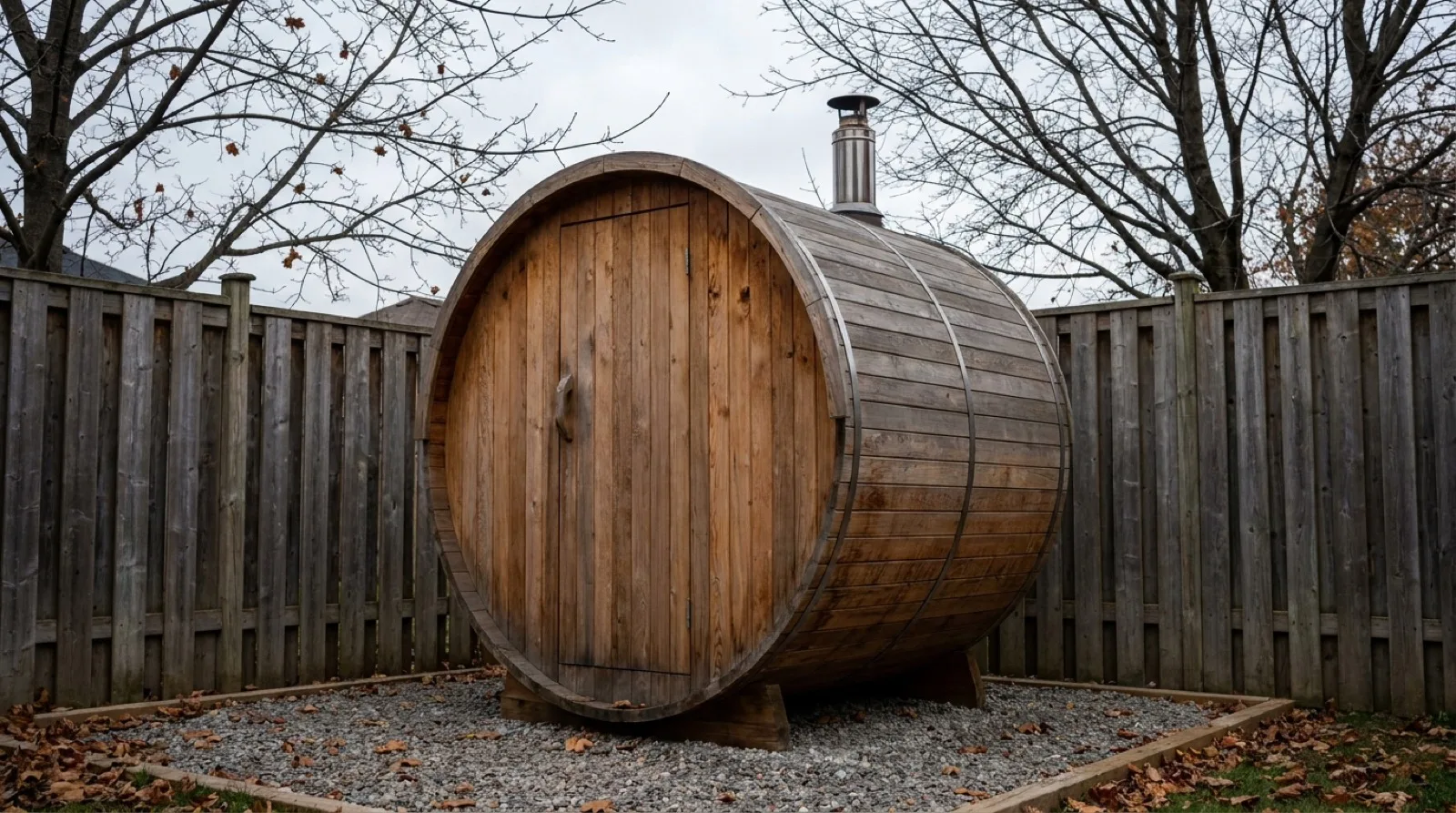
The curve is doing thermal work
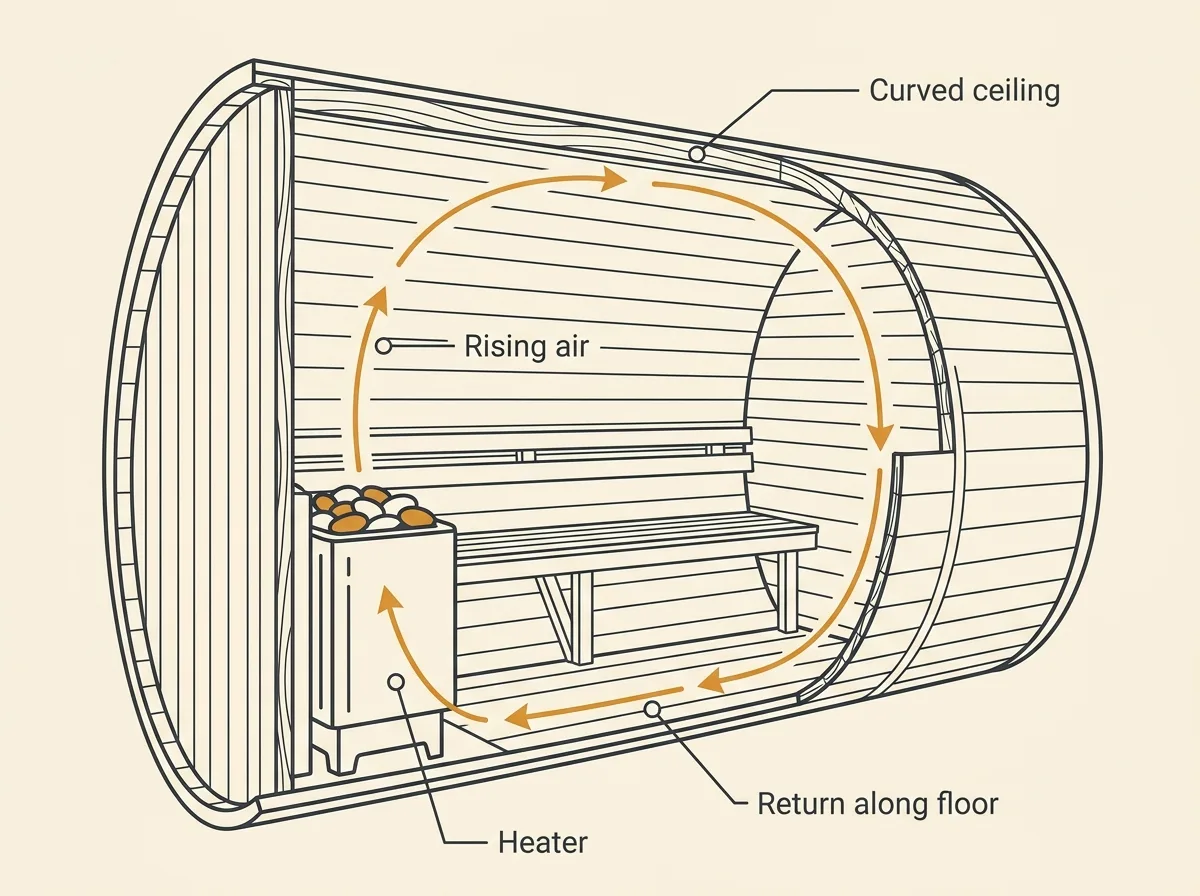
A barrel sauna works as a convection loop inside a cylinder. Air heats at the stove, rises, follows the curved ceiling to the far end, cools slightly against the wood and drops back down to floor level. Two vents keep that loop fed. The heater's output band sets both the pace of the loop and the price.
Take a rectangular room and round off the ceiling and floor into a cylinder and two things change. The volume of air drops for the same floor length, because the corners are gone, and every rising column of hot air now meets a continuous curved surface rather than a right angle. Corners are where a square sauna room stalls: air moving along the ceiling hits the junction with the wall, loses momentum and sits there. The barrel gives that air nowhere to stall, so it keeps travelling along the arc to the far end and slides down the far wall.
The volume difference is the practical consequence. Heater sizing is a function of the air volume, plus corrections for any uninsulated surface such as a glass door. A barrel holds less air than the square room its footprint would suggest, so the same length of sauna can often be run on a smaller heater than a rectangular build. That is where the shape converts into money, because heater prices move in steps rather than smoothly, and dropping below a step boundary is worth more than shaving a few hundred dollars inside a band.
Where the air comes in and where it leaves
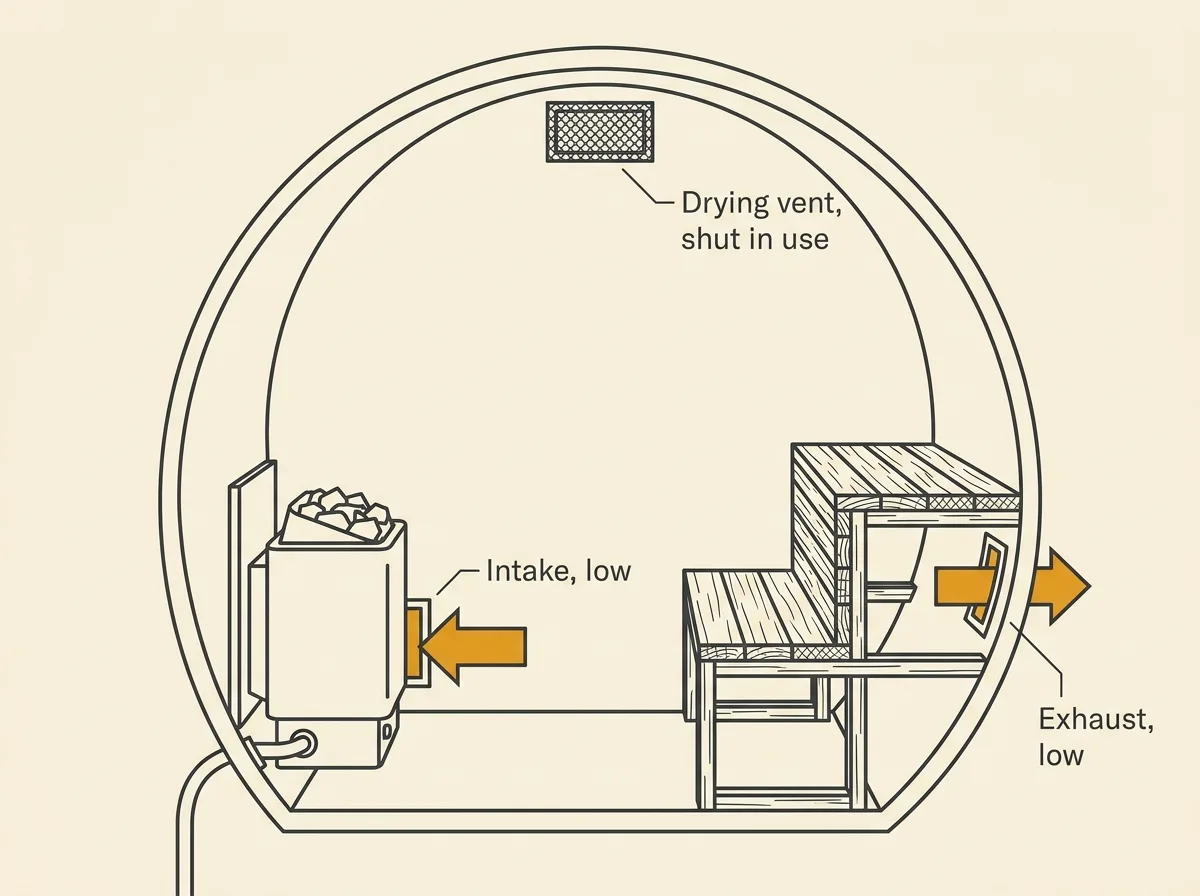
A barrel has two openings that matter and they are both usually low. The intake sits near the floor beside or beneath the stove, so cold outside air is drawn straight into the rising column and heated immediately rather than pooling across the floor. The exhaust sits on the opposite wall, commonly low and hidden under or behind the bench, so the loop has to travel the length of the barrel before anything leaves.
Putting the exhaust high is the mistake worth naming. A high outlet takes the hottest layer of air straight out of the room, which is exactly the layer sitting at bench height where people are. The room then reads as cool at the bench while the heater works continuously. Some barrels add a separate high vent that stays shut during a session and opens afterwards to dry the interior, which is a drying function rather than part of the running loop. The two jobs get confused because both involve a hole in the wall near the ceiling, and only one of them should be open while the stove is running.
The kilowatt step you actually pay for
Canadian retail pricing for electric heaters moves in three visible bands. Sauna Depot, a Canadian retailer whose page does not declare a currency, lists Harvia electric sauna heaters at $1,268.00 to $1,916.00 across the 1.9 kW to 4.5 kW band, with $1,300.00 as the typical figure. The 6 kW to 9 kW band runs $1,763.00 to $2,864.00 at the same retailer, typically $1,947.00. The 10 kW to 16 kW band runs $2,190.00 to $4,776.00, typically $3,001.00.
Read those as steps rather than a smooth curve. Moving from the small band to the middle band costs roughly the difference between a typical $1,300.00 and a typical $1,947.00 at Sauna Depot, and moving to the top band is a bigger step again, from that typical $1,947.00 to a typical $3,001.00. A barrel that lands just inside the 6 kW to 9 kW band because of an oversized glass end will carry that step for its whole life. Sauna Depot also lists the Harvia Virta Combi, a sauna heater with a water reservoir, at $4,746.00 to $4,819.00 in the 9 kW to 10.5 kW range, which overlaps the top of the plain electric range rather than sitting above it: the 16 kW Virta Pro at $4,776.00 falls inside that $4,746.00 to $4,819.00 combi band. Calore Health and Wellness (Canada) prices a heater supplied as a kit with its controller at $1,337.11 to $4,127.97, typically $2,782.98, which is the same decision bundled with the control gear.
The stones are the storage
Heat storage happens in the stone set rather than in the heater's element. Stones absorb output during the warm-up, hold it, and release it back into the room in a burst when water is thrown across them. That burst is the point of a traditional barrel, and it is why a heater with too small a stone capacity feels weak even when its kilowatt rating looks correct on paper. Topture, a US retailer in Sheridan WY, prices a sauna stone set at US$60 to US$120, with the figures in US dollars inferred from the retailer's address because the page states no currency.
Stone capacity is also the argument for the heavier heaters at the top of each band. Two units rated the same in kilowatts can hold very different stone masses, and the one holding more will ride through repeated water throws without the room dropping. That specification sits on the heater's own datasheet rather than in any price table, so it is a question for the supplier. The index does not record product specifications for any company, only the business record itself.
Wood-fired in the same shell
A barrel takes a wood stove as readily as an electric heater, and the price structure is different. Topture, a US retailer in Sheridan WY, prices a wood-burning sauna stove from US$969 for a Harvia M3 alone up to US$2,580 for the complete kit with chimney and stones, again in US dollars inferred from the retailer's address. Against the Canadian electric bands from Sauna Depot, the wood route removes the electrical supply problem from the project and replaces it with a chimney, a clearance calculation and a fuel habit.
Controls are where the electric route recovers ground. Topture, in US dollars, prices a HUUM UKU controller at US$1,000 to US$2,250 and a HUUM HIVE Mini electric heater at US$2,502 to US$2,785. A controller is what lets a barrel be brought up to temperature before anybody walks outside to it, which is a real consideration in a climate where the walk itself is the deterrent for much of the year.
What the shell costs before any heater
Barrel pricing splits by whether installation is included. Great Canadian Saunas (Flesherton, ON) prices a cedar barrel sauna, 7 ft in diameter and 4 ft to 12 ft long, at $5,495 to $9,495 with a typical figure of $7,495, and states professional delivery and installation are included within its stated area. Backyard Canada, a Canadian retailer, prices the Canadian Timber barrel line, covering the Harmony 6 ft by 6 ft, Serenity and Tranquility, at $7,509 to $8,226 kit only, typically $7,751. The same retailer prices a Panoramic View Cedar Barrel Sauna at $13,729 kit only, marked down from $14,999, which is what a large glass end does to the number.
Of the 39 companies in the index, 38 carry the Saunas category, and 21 of the 39 are filed under the sauna store label that Google Maps assigns. Barrel shells are a stocked product rather than a built one for most of that supply. Two of the 39 records carry a manufacturer label and one a steel fabricator label, which is the whole of the making side of this index against 21 stores. The saunas page lists the companies, the outdoor sauna cost page holds the full shell and installation table, and the barrel versus cabin comparison covers the shape decision itself.
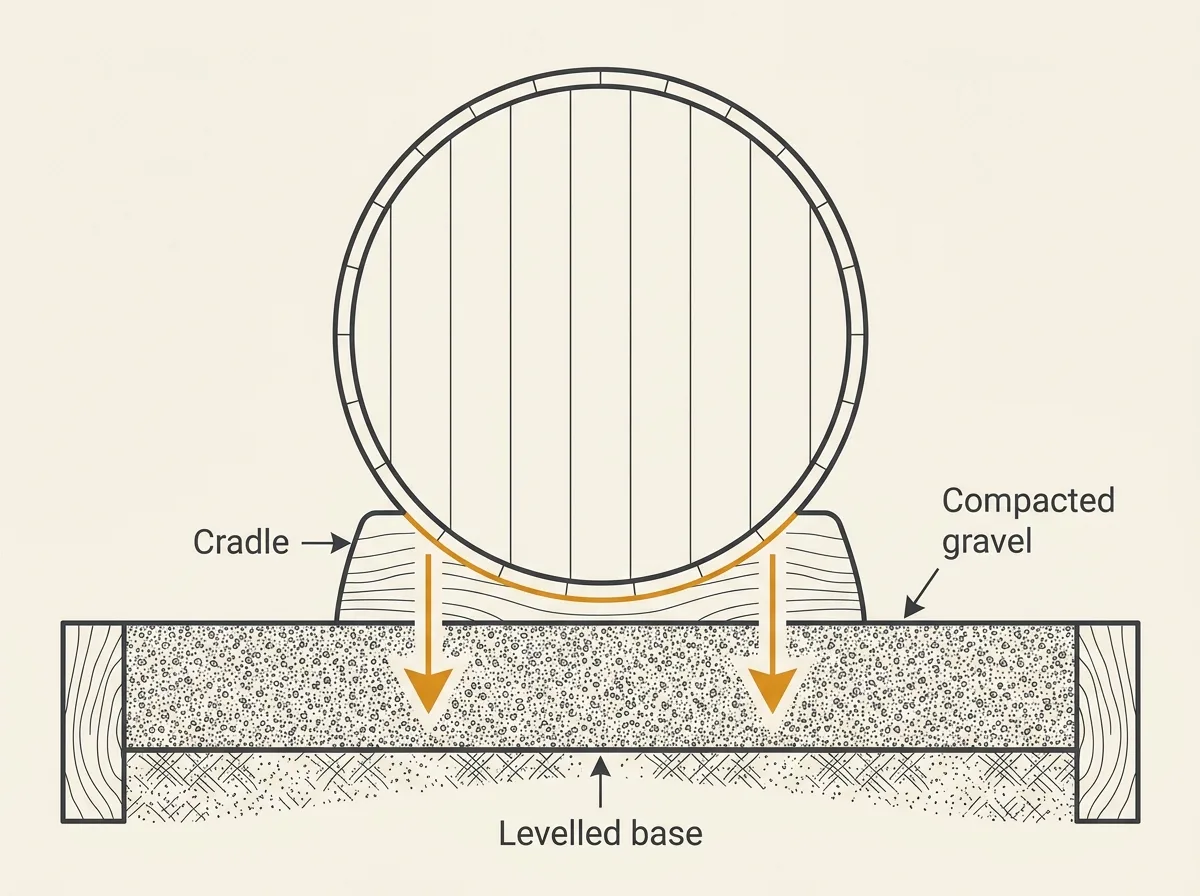
The shell also has to stand on something flat, level and drained, because the cradles a barrel sits in concentrate its weight on a few narrow contact points. Topture, a US retailer in Sheridan WY, prices a compacted gravel pad built DIY at US$300 to US$800 and a poured concrete slab at US$800 to US$2,500, both in US dollars inferred from the retailer's address since the page states no currency, and prices a plate compactor rental for pad preparation at US$80 to US$120 per day. A barrel that settles unevenly stops sealing at the door, and a door that stops sealing undoes the vent design described above.
Frequently asked questions
Why is a sauna barrel-shaped instead of square?
- The curve removes the corners, which cuts the volume of air the heater has to bring up to temperature for a given floor length, and it gives rising air a continuous surface to travel along and return down. A square room of the same footprint holds more air and holds it in corners the convection loop reaches last.
What size heater does a barrel sauna need?
- The heater is sized to the room volume, and Canadian retail prices step with that sizing. Sauna Depot lists Harvia electric heaters at $1,268.00 to $1,916.00 for the 1.9 kW to 4.5 kW band, $1,763.00 to $2,864.00 for 6 kW to 9 kW, and $2,190.00 to $4,776.00 for 10 kW to 16 kW.
Where do the vents go in a barrel sauna?
- Air enters low, close to the heater, so incoming air is pulled straight into the rising column. It leaves through a second opening on the far wall, usually low and under or behind the bench. Both openings being low keeps the hottest layer at bench height instead of pushing it straight out.
Does a barrel sauna need a foundation?
- The shell sits on cradles that need a flat, level and drained base rather than a full slab. Topture, a US retailer, prices a compacted gravel pad done DIY at US$300 to US$800 and a poured concrete slab at US$800 to US$2,500, with figures in US dollars inferred from the retailer's US address since the page states no currency.